Supplementary material Double-blind review
Language-Guided
Static Grasp Synthesis
We study how language can control the shape of a 3D hand around an object, using the bend of each finger as an intermediate representation.
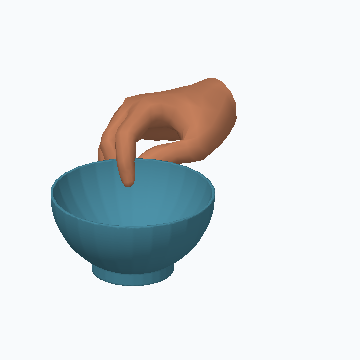 VIEW C
01 Method
From instruction to pose
The intermediate representation lets us evaluate language translation separately from the pose the generator actually produces.
- 01 / INPUT
Text instruction
Translate a natural-language request into a desired bend level for each of the five fingers.
- 02 / CONTROL
Five finger commands
Use ten angle bins for the four proximal interphalangeal joints and the thumb’s metacarpophalangeal joint. Higher bins indicate greater extension.
- 03 / OUTPUT
Static hand mesh
Condition the grasp generator on the object and the five commands, then measure the realized finger angles on the resulting mesh.
02 Prompt styles
Three prompt styles
Compare three ways to describe the same reference pose, from detailed finger states to a brief cue.
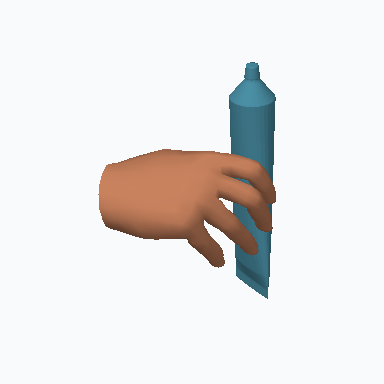
-
Tier 01Detailed
Specifies the state of most or all fingers.
Aim for mostly straight ring and pinky fingers and a bent index finger; the middle finger and thumb MCP should be partly bent.
-
Tier 02Conversational
Describes selected fingers or how they relate to each other or the object.
On the tube, keep the thumb tip farther toward the nozzle than the ring fingertip. Leave the pinky tip some room.
-
Tier 03Brief
Gives one key constraint or a short cue for the whole hand.
Pinky tip clear of the tube.
The conversational and brief prompts were written for the shown poses and checked against measured joint angles or fingertip geometry.
03 Qualitative examples
Grasps across objects
Explore selected text-to-grasp outputs, then inspect a separate set of poses produced with geometric refinement.
Direct generation
Each card shows the original instruction and a render of the corresponding object-conditioned mesh before geometric refinement.
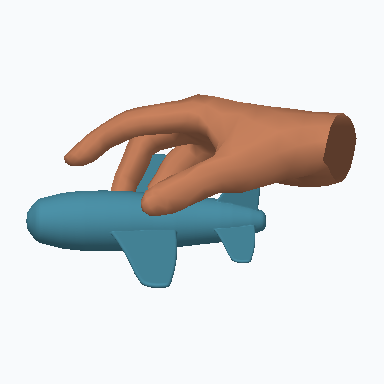
Keep the index, ring and pinky mostly straight; let the middle PIP and thumb MCP be partly bent.
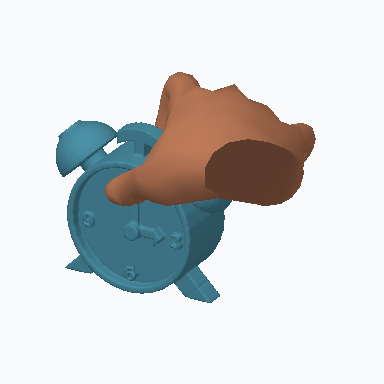
Keep the middle mostly straight while the index, ring and pinky are bent. Leave the thumb MCP partly bent.
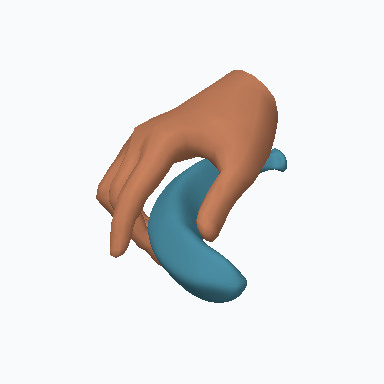
Keep the index mostly straight, with the ring bent. Let the middle, pinky, and thumb MCP be partly bent.
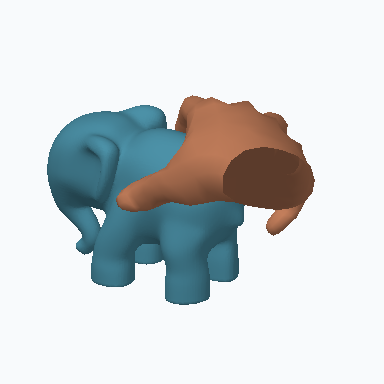
Use a mostly straight index finger and a bent ring finger, with the middle and pinky partly bent and the thumb MCP partly bent.
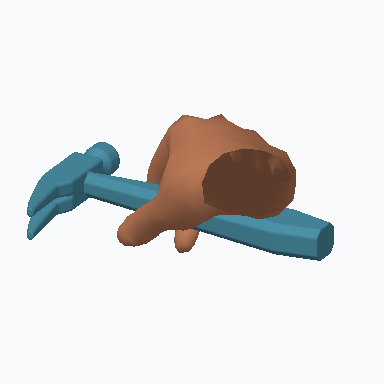
Let the index and middle fingers be mostly straight while the ring and pinky fingers are bent, and keep the thumb MCP joint partly bent.
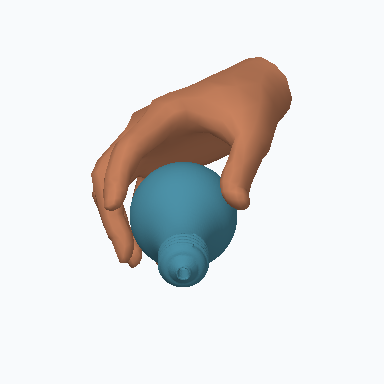
Keep the index and pinky mostly straight, and leave the middle and ring partly bent. Keep the thumb MCP partly bent as well.
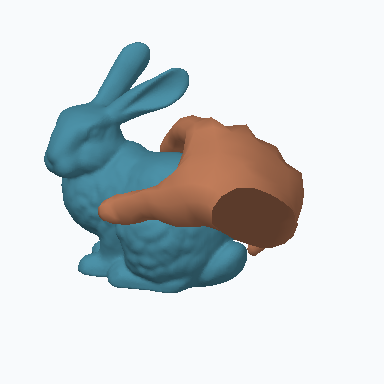
Keep the index, middle, ring, and thumb MCP mostly straight, with the pinky partly bent.
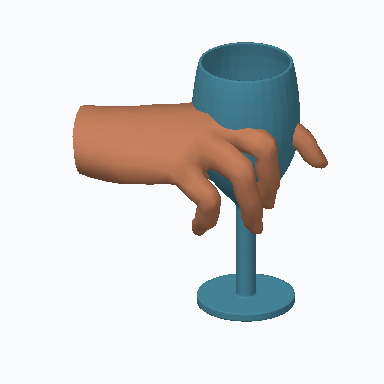
Keep the index finger mostly straight while the middle finger is bent. The ring and pinky fingers, along with the thumb MCP, should be partly bent.
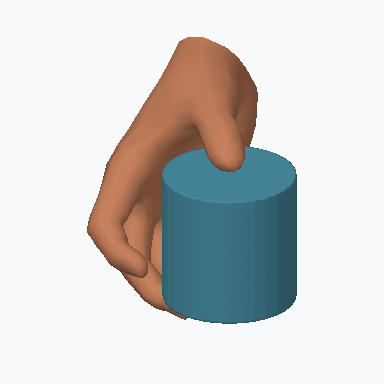
Keep the index, middle, ring and pinky PIP joints partly bent, and the thumb MCP partly bent too. The index PIP should be more bent than the pinky PIP.
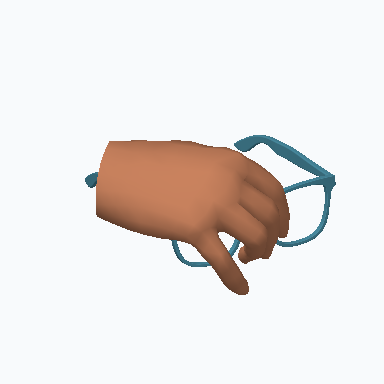
Use a mostly straight pinky with the index, middle, and ring partly bent; keep the thumb MCP partly bent.
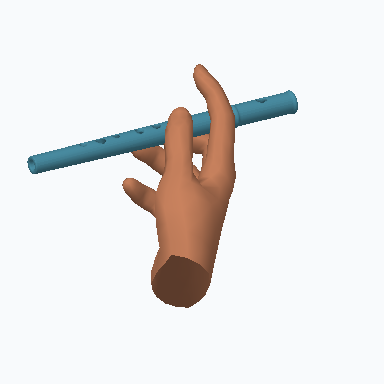
Keep the middle bent and the ring and pinky partly bent. The index PIP and thumb MCP should be mostly straight.
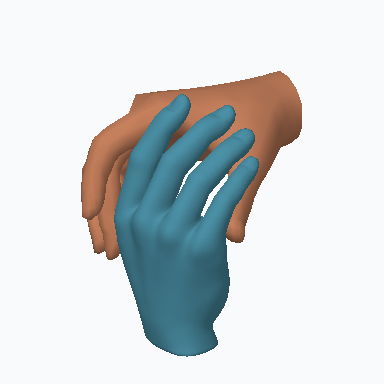
Keep the middle finger mostly straight and the thumb MCP partly bent. The index, ring, and pinky fingers should be partly bent, with the pinky more bent than the index and ring fingers.
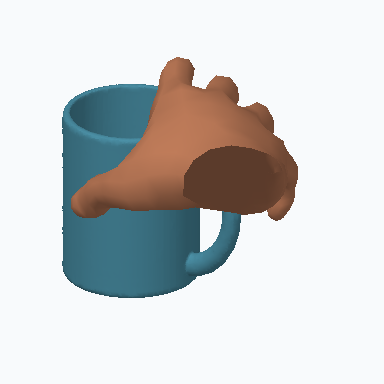
Keep the index and pinky mostly straight, with the middle and ring bent. Leave the thumb MCP partly bent.
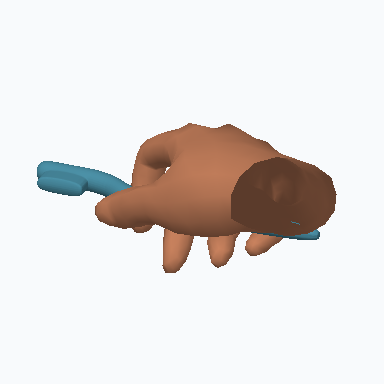
Keep the index, ring, and pinky bent at their middle knuckles, with the middle finger partly bent and the thumb MCP mostly straight.
These selected poses use known object classes and passed the finger-state and sampled geometry checks for this run. The checks allowed up to 3 mm of sampled penetration.
Geometric refinement
These poses use manually specified regions on seen objects. Change the object or camera to inspect each pose.
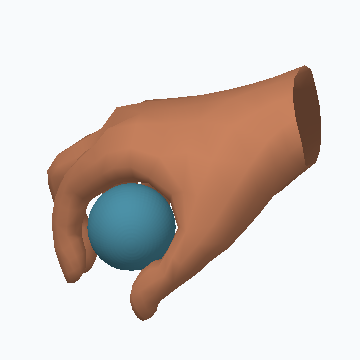 VIEW C
Object
Instruction
“Pinch the small sphere.”
The refinement targets opposing regions of the sphere with the thumb and index finger.
Camera view
The refinement study evaluated 18 fixed candidates across six tasks. Four tasks passed all predefined geometric and task-specific checks. The elephant and banana refinement tasks failed.
04 Quantitative evaluation
Translation and realization
We compare text-only and text-plus-point-cloud control on 304 synthetic prompts with novel instruction chains across 19 objects held out from language-model fine-tuning.
| Evaluation stage | Text only | Text + PointNet |
|---|---|---|
| Predicted finger commands | 12.50% | 25.33% |
| Realized finger angles | 30.92% | 24.34% |
Point-cloud conditioning improved command translation on this split, while strict satisfaction in the generated angles declined. Both variants used the same grasp generator, trained on all 50 objects in the benchmark. The evaluation used fixed single-seed adapters and measured finger constraints only.